The Volcanic Ledges of Kalaupapa and the Shore Where No One Wiped Away Tears
On the morning of May 10, 1873, the steamer Kilauea drops a thirty-three-year-old Belgian priest beneath the two-thousand-foot vertical cliffs of Kalaupapa peninsula; standing before eight hundred banished Hansen’s disease sufferers rotting without medical care, Father Damien quietly tucks his white linen gloves deep into his cassock pocket to bind the first open ulcer with his bare hands.
 UNGLOVED HANDS
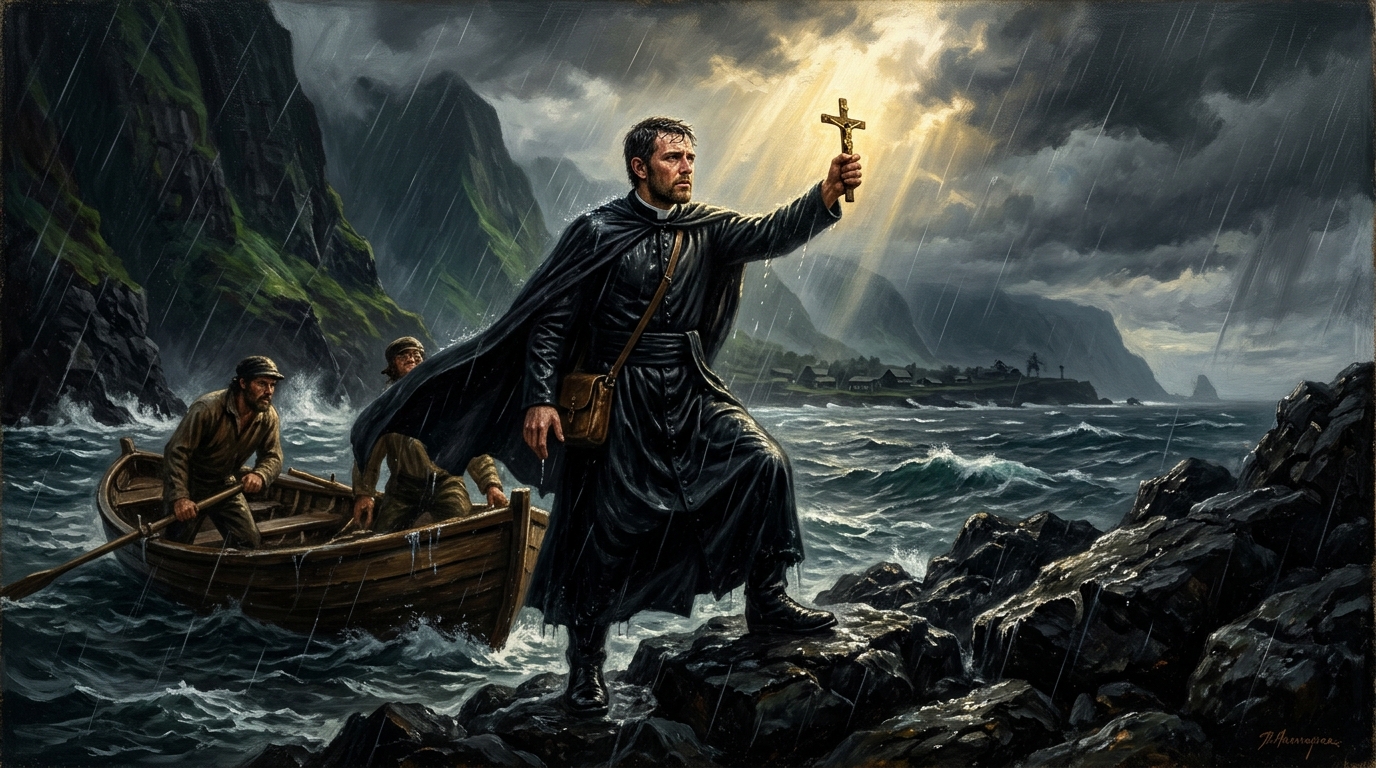
Heavy Pacific rollers crashed against the black basalt ledges, flinging stinging salt spray across the black cassock of the thirty-three-year-old priest braced in the bow of the wooden whaleboat. On Saturday morning, May 10, 1873, the inter-island steamer Kilauea had dropped anchor several hundred yards off the northern coast of Molokai because not a single sailor aboard dared bring the vessel close to shore. Terror of contagion froze the crew in their tracks. Even the cattle brought as provisions were shoved straight over the rail to swim for the rocks on their own, while fifty newly rounded-up Hansen’s disease sufferers torn from their families in Honolulu huddled in the bottom of the boat like prisoners riding a tumbril to the scaffold.
Before the eyes of Jozef De Veuster—the Flemish farm boy from Tremelo, Belgium, known in the Congregation of the Sacred Hearts as Father Damien—rose a sheer volcanic wall more than two thousand feet high that sealed the peninsula of Kalaupapa and the valley of Kalawao off from the rest of the earth. Behind that gray-green precipice shrouded in mist lay no footpath by which a man could climb out, and on the other three sides roared deep ocean waters ringed with razor-sharp coral reefs and sharks. Ever since 1866, when King Kamehameha V signed the Act to Prevent the Spread of Leprosy across the Hawaiian Kingdom, this low volcanic tongue of land had served as a natural prison without iron bars—a graveyard where the living were buried before their hearts stopped beating.
The Two-Thousand-Foot Wall and the White Linen Gloves in the Cassock Pocket
As the keel scraped against the slick shelf of sea moss, Bishop Louis Maigret watched from the steamer’s rail as the young missionary stepped ashore after volunteering to take the place of his ailing brother in Europe. The bishop’s parting blessing sounded like the prayers for the dying, for both men knew that no foreign physician or priest had ever entered Kalawao to live among the outcasts. Father Damien carried nothing onto the lava rocks except the cassock on his back, his worn Breviary, and a pair of spotless white linen gloves that an anxious benefactor in Honolulu had pressed into his hands before departure with a stern warning: “Father, keep these gloves on at all times; never let your bare skin touch their flesh!”
Walking across the jagged crust of lava toward the settlement of Kalawao, the scene laid bare under the blazing midday sun squeezed the young priest’s chest like an iron vise. There were no real houses standing. More than eight hundred human beings—from blind elders to seven- and eight-year-old children wrenched screaming from their mothers’ arms on the docks of Honolulu—were crammed into makeshift hovels patched together from dry pandanus branches, rotting grass, and foul-smelling cowhides. A suffocating stench of gangrenous flesh, dried pus caked onto filthy rags, and fermented ki-root liquor hung thick in the salt air, forcing bitter bile into the missionary’s throat.
There was no doctor. There was no nurse. There was not a single roll of clean gauze or a pipe bringing fresh water to the huts. The dying lay directly on damp dirt floors crawling with maggots; when they breathed their last during the night, their fellow sufferers barely had strength to drag the corpses out to shallow sand pits where wild pigs and starving dogs rooted before dawn. Worse even than the decay of the body was the collapse of the human spirit: declared “civilly dead” by royal law, stripped of spouse, land, and name, many drowned their agony in frantic drunkenness, violence, and the bitter maxim carved into the rocks: “In this place there is no law, and there is no God!”
The First Night Beneath the Hala Tree in the Graveyard of the Living
On his first night on death island, Father Damien could find no clean roof under which to lay his head. He spread his black cloak across the gnarled roots of an ancient hala tree beside the windswept burial ground and lay awake beneath the cold stars. The whistle of the trade wind through thorny pandanus leaves mingled with the hoarse, rasping groans of throats eaten away by leprosy rising from the huts all around him. In that pitch darkness, the natural survival instinct of a healthy thirty-three-year-old Flemish farmer’s son who could hoist hundred-pound grain sacks on his shoulders shuddered at the thought that his own strong fingers would one day rot and drop off into this very sand.
As a blood-red dawn broke over the crest of the Pali cliffs the next morning, a native man named Hoolehua dragged himself out of a grass hovel a few yards from the hala tree. His face was horribly disfigured by leprous nodules, and both of his fingerless feet bled into the black dirt as he crawled toward a gourd of water. Conditioned by years of being driven off with stones by healthy men, the moment he caught sight of the foreign priest’s black cassock he shrank back, pulled a torn piece of matting over his face, and rasped through a ruined throat: “Stay back! Keep downwind, Father! I am rotting alive!”
Father Damien stopped in his tracks. His right hand brushed the side pocket of his cassock, where the pair of white linen gloves lay folded beneath his wooden Rosary beads. That single heartbeat decided the entire course of the sixteen years remaining to him on earth. If he slipped those white gloves onto his hands to preserve the sanitary distance of government officials who tossed sacks of poi onto the beach from offshore boats, he would remain forever a kindly warden gazing at the condemned from the safe side of the abyss. Yet the Christ of the Gospels had never touched a leper through a layer of protective cloth.
The Moment the Gloves Were Put Away and the Touch That Broke the Exile
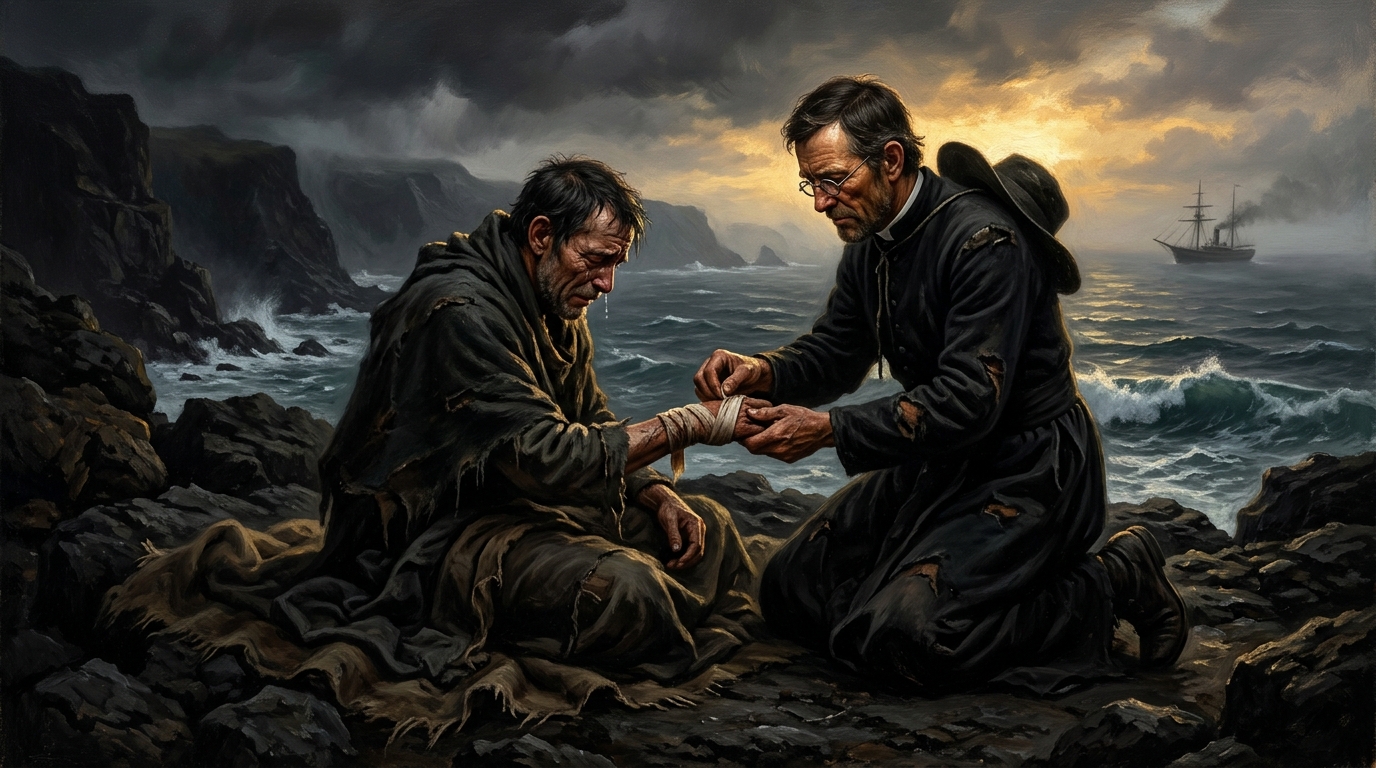
The young priest pulled the white linen gloves from his pocket, looked at them for one brief second, rolled them into a tight ball, and shoved them to the very bottom of his cassock pocket. He took two steps forward and dropped onto both knees in the mud stained with blood and dust beside Hoolehua. Without a flicker of hesitation, the bare, warm, calloused hands of the Belgian farm boy rested squarely upon the trembling shoulders of the leper. Lifting the gourd of cool water, Damien washed away with his own bare fingers the crusts of dried black blood and grit clinging to the deep ulcer on the stranger’s foot.
Hoolehua froze. For five years—ever since policemen had shoved him with rifle butts into the hold of the prison ship in Honolulu—not a single healthy hand had touched his skin. Hot tears welled up from his swollen, lashless eye sockets and splashed onto the back of the priest’s ungloved hand. Around the hala tree, dozens of mutilated figures began peering out from the dark doorways of their huts. In dead silence they stared at the man in the black cassock who was tearing strips from his own white cotton undershirt to bind, with bare hands, the suppurating wound of a dying outcast.
The Vow Under the Hala Tree and the Tropical Tempest Breaking Overhead
Rising to his feet inside the circle of disfigured men, women, and children holding their breath, Father Damien held aloft his small wooden Crucifix in a bare hand stained with the sick man’s blood. Speaking in the straightforward Hawaiian tongue he had spoken for nine years on the Big Island, his resonant voice carried above the roar of the surf: “My brothers and sisters! I have not come to Molokai to visit you for a few weeks and take the next steamer back to Honolulu. From this hour on, Kalawao is my home, and I am your father who will live and die with you!” Yet that very afternoon, a violent tropical squall swept down from the mountain cliffs, ripping the rotten grass roofs off the huts and uncovering unburied corpses in the mud—plunging the unarmed priest straight into his first battle for their lives.
“And Jesus having compassion on him, stretched forth his hand; and touching him, saith to him: I will. Be thou made clean.”— The Gospel according to Saint Mark 1:41
Lord Jesus, moved with compassion You stretched forth Your bare hand to touch the leper when the whole world fled from him. Grant us the fearless heart of Saint Damien upon the volcanic ledges of Kalaupapa, that we may put away our selfishness and our dread of losing comfort, kneeling in tenderness beside the forgotten and the wounded. Amen.
Biblical & Historical Questions Answered
Why did the Kingdom of Hawaii banish leprosy patients to the Kalaupapa peninsula on Molokai?
Who was Saint Damien of Molokai before he landed on the island in May 1873?
What is the spiritual significance of Father Damien putting away his white gloves to work with bare hands?
Carry This Story Into Silent Prayer
Light a free 24-hour vigil candle for someone you love or rest in the candlelit Chapel.