Neither in the Earthquake Nor the Flame: The Gentle Whisper at Horeb’s Cave
Red granite cracks beneath a mountain-splitting gale, the earth convulses from its roots, and a wall of fire sweeps across Mount Horeb, yet Elijah pulls his scorched sheepskin mantle across his face and steps out only when he hears the whistling of a gentle air.
 STILL SMALL VOICE
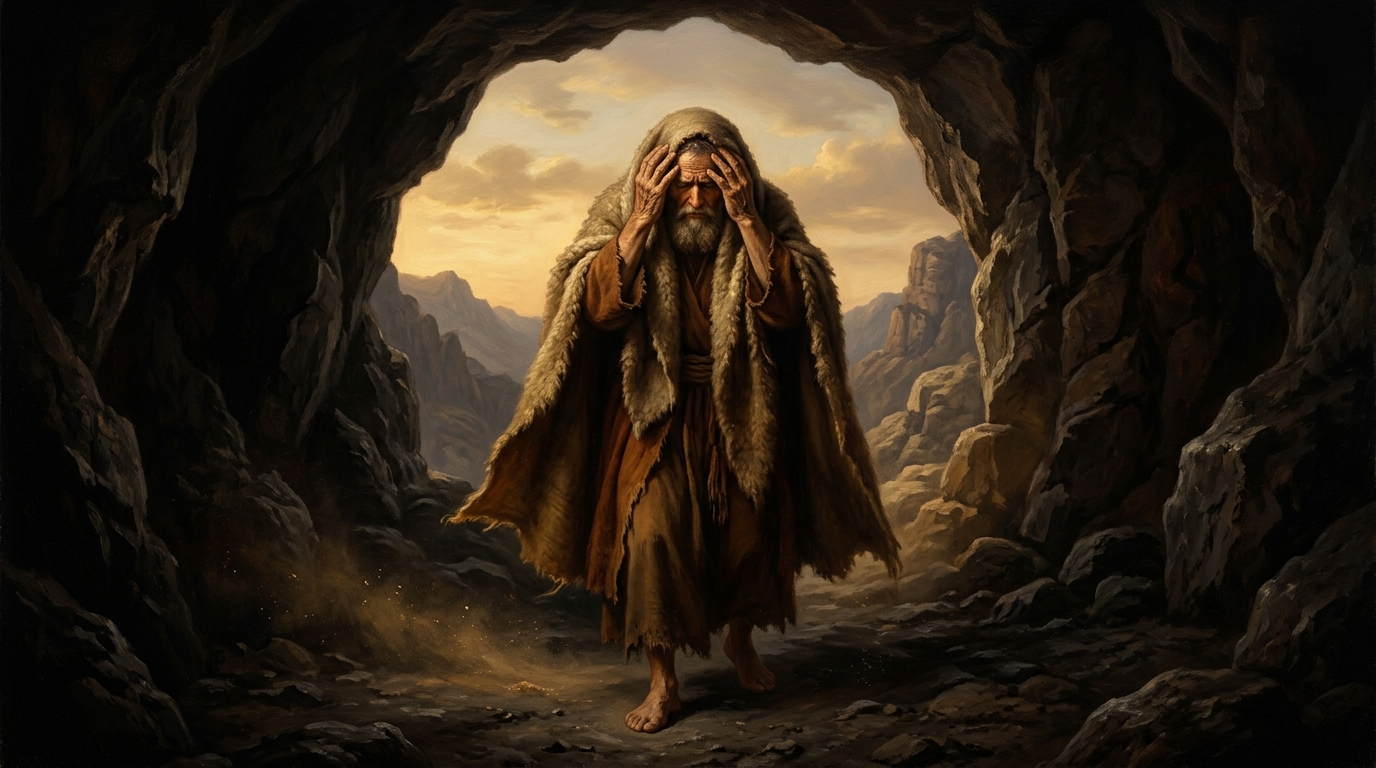
Red granite beneath Elijah’s bare feet began to shudder like the spine of a waking leviathan. Outside the mouth of Mount Horeb’s cave, a hurricane-force gale dropped out of the upper sky, howling down Sinai’s gorges with a violence that tore crags from the mountain and shattered boulders into flying shrapnel. Hard on the heels of the wind came an earthquake that convulsed the mountain’s roots and rained stone chips from the cavern roof, followed immediately by a roaring sheet of fire that scorched the cliffside white-hot. Yet standing back inside the cave’s shadow, the prophet who had once called down fire upon Mount Carmel did not budge. He did not step out. A deep sacred instinct told him why: the Lord was not in the wind, the Lord was not in the earthquake, and the Lord was not in the fire.
Before that terrifying display shook the mountain, in the pitch-black stillness of the previous night inside the cave, a brief, piercing question had echoed through his conscience: “What dost thou here, Elias?” God did not ask, “How many miles have you walked?” He asked, “What are you doing here, shut inside this cave?” It was the surgical question of the Divine Physician inviting a bruised soul to name the hidden infection festering beneath its grief.
“What Dost Thou Here, Elias?”: The Spiritual Trap of “I Alone Am Left”
And Elijah poured out years of pent-up anguish in one rushing breath: “With zeal have I been zealous for the Lord God of hosts: because the children of Israel have forsaken thy covenant, they have thrown down thy altars, they have slain thy prophets with the sword, and I alone am left, and they seek my life to take it away.” Every word of his lament described real wounds, yet at the same time it exposed the most perilous spiritual trap awaiting devoted believers: the “I alone am left” syndrome.
Whenever someone pours out their lifeblood for God or carries a family’s burdens without seeing the fruit they hoped for, bitter isolation easily sets in. Elijah had unconsciously fused the success of God’s kingdom with the visible triumph of his own ministry. He assumed the Almighty could only conquer through thunderbolts and public spectacles like Mount Carmel—and that if Carmel’s fire had failed to break Queen Jezebel, then God’s entire covenant cause had collapsed.
God did not argue theology with His wounded servant. He simply commanded: “Go forth, and stand upon the mount before the Lord: and behold the Lord passeth.” Then He caused the three most overwhelming symbols of Old Testament power—mountain-rending wind, ground-splitting earthquake, and devouring flame—to march past the cave mouth one after another. Those were the very weapons of storm and judgment Elijah had longed to see leveled against Israel’s idolaters.
Gale, Earthquake, and Fire: When God’s Power Refuses the Spectacle
Yet three times in succession, Sacred Scripture repeats the refrain that overturns every human calculation of divine power: “the Lord is not in the wind... the Lord is not in the earthquake... the Lord is not in the fire.” Spectacle and terror can force a crowd on Mount Carmel to fall on their faces for an afternoon, but they can never heal a broken heart or win the free love of a human soul.
Then the flames died out. Pulverized rock dust settled onto the ledges. Across the absolute hush blanketing Horeb’s summit came what the original Hebrew text calls “qol demamah daqqah”—the sound of a sheer, gossamer stillness, what the Douay-Rheims Bible renders as “a whistling of a gentle air,” soft as a mother’s breath against a sleeping infant’s cheek. Not a pebble cracked. Not a dry thorn snapped. Yet right inside that weightless, quiet breeze, the Creator of galaxies stood personally present.
The instant Elijah heard that gentle whisper, a tremor of holy awe ran through his frame. Without hesitation he lifted his sheepskin mantle—the very mantle scorched by Carmel’s fire that had wrapped his shivering shoulders beneath the desert broom tree—drew it across his face, walked out, and stood at the entering in of the cave. Why hadn’t the prophet covered his face before the hurricane or the inferno, yet veiled his eyes before a whisper of air? Because in the gale and the fire only created forces were passing by; in the gentleness of that breeze, he stood face to face with the living holiness and unfathomable tenderness of God Himself.
Veiling the Face Before the Gentle Air and the Heart of Contemplative Prayer
Carmelite mystics such as Saint John of the Cross and Saint Teresa of Avila have revered this threshold of Horeb’s cave as the summit of Catholic contemplative prayer. God rarely speaks inside the racket of wounded pride, impatient anger demanding instant vindication, or restless inner noise. To hear the Holy Spirit’s “whistling of a gentle air,” a soul must allow the gales of ego, the earthquakes of anxiety, and the fires of resentment to pass by and fall still. Only when our frantic need to control outcomes falls silent at the cave entrance does the gentle breath of Divine Mercy knit our fractured spirit back together.
Out of that gentle breeze, the voice of the Lord asked the question a second time, now stripped of all sting: “What dost thou here, Elias?” Though the prophet repeated his familiar lament word for word, his posture told a different story: he was no longer curled in desert dust begging for death, but standing upright on the rock threshold, ready to listen and obey without conditions. Immediately the Lord handed him three final remedies to cure his burnout and loneliness for good.
Seven Thousand Unbowed Knees and the Mantle Cast Upon Elisha
First, God restored to him a concrete future mission: to return along the wilderness road toward Damascus and anoint new instruments of Providence for the next chapter of salvation history. Second, God gave him a companion, disciple, and successor—Elisha the son of Shaphat—so Elijah would never again walk through dark valleys alone. Third, the Lord gently dismantled Elijah’s “I alone am left” illusion with a revelation that has comforted believers for three millennia: “And I will leave me seven thousand men in Israel, whose knees have not been bowed before Baal, and every mouth that hath not worshipped him kissing the hands.”
All those years while Elijah thought he was fighting utterly alone in an apostate nation, God’s quiet grace had been sheltering seven thousand faithful souls praying in hidden fidelity! Lowering the sheepskin mantle from his weathered face, Elijah breathed deep the crisp mountain air of Horeb and strode down the granite slopes. When he found young Elisha plowing behind twelve yoke of oxen, he cast that same fire-scarred, desert-stained mantle across the younger man’s shoulders—sealing forever the truth that whoever learns to hear God in the gentle whisper never walks alone again.
“And he said to him: Go forth, and stand upon the mount before the Lord: and behold the Lord passeth, and a great and strong wind before the Lord, over throwing the mountains, and breaking the rocks in pieces: the Lord is not in the wind. And after the wind, an earthquake: but the Lord is not in the earthquake. And after the earthquake, a fire: the Lord is not in the fire. And after the fire, a whistling of a gentle air.”— The First Book of Kings 19:11-12
Almighty and ever-gentle God, how often we demand that You solve our crises with thunderbolts and dramatic signs on our timetable! Standing today at the mouth of Mount Horeb’s cave beside the prophet Elijah, we ask for the grace to recognize Your presence in the gentle whisper of interior peace, in quiet evening prayer, and in the faithful companions You place along our road. Heal us of the illusion that we carry our burdens alone, and renew in us the quiet joy of serving You. Through Christ our Lord. Amen.
Biblical & Historical Questions Answered
What does the phrase 'a whistling of a gentle air' (or 'still small voice') mean in 1 Kings 19:12?
Why did Elijah wrap his face in his mantle only when he heard the gentle breeze?
What is the significance of the 7,000 in Israel who had not bowed their knees to Baal (1 Kings 19:18)?
Carry This Story Into Silent Prayer
Light a free 24-hour vigil candle for someone you love or rest in the candlelit Chapel.